

Over 52% of US businesses outsource at least one business function. There’s a high adoption rate in HR (80%), customer support operations (60%), and finance (over 40%) because this model works.
When you partner with a business services provider (also known as a business process services provider or non-IT managed service provider), you gain cost efficiency, flexibility, speed, and access to a global talent pool with specialized skills.
There are questions to be had, such as:
- Is getting a service provider better than offshoring, onshoring, or getting freelancers instead?
- What specific tasks or business segments do you want to source from another country?
- How does that work in terms of capital?
Mid-sized and enterprise firms are especially likely to partner with service providers to stay competitive, compliant, and agile in a dynamic marketplace. You need to grow fast, stay compliant with US regulations, and keep costs down.
This guide will help you determine if your business is a good fit for partnering with a managed business services provider and provide an overview of the process.
In this blog, you will learn:
- What is a business service provider or a non-IT managed services provider?
- Which services can you outsource with a provider?
- How managed services help you scale faster, cut costs, and stay reliable.
- The differences between hiring a business services provider, offshoring, and using freelancers.
- How to pick the right partner—what to check for compliance, service quality, and staffing.
- What you can expect to pay, and why prices vary.
What is a Managed Services Provider And How Is It Different From Other Models?
There are many forms of outsourcing, but we’ll only tackle three below for their differences in cost, control, and flexibility.
Hiring Remote Freelancers
Hiring remote freelancers has the lowest upfront costs per full-time equivalent.
Going this route is effective if:
- You want a 100% direct working relationship/management with an agreed outline of tasks.
- You’re a solopreneur or a micro-business.
- You need anywhere from 1-10 staff (it works best for small teams)
It’s the most affordable because:
- More flexible cost structure – you can pay by the hour, by the project, or with a fixed monthly retainer that includes outlined tasks.
- Very low overhead costs – you can hire skilled freelancers in the role you’re filling with little to no onboarding required, and you can expect miscellaneous costs folded into the pricing. Freelancers usually file their own taxes, get their own healthcare, etc.
Some things to keep in mind:
- Get a professional freelancer – some countries like the Philippines have professional freelancers that are nationally registered like a business. They can issue receipts for services rendered, and this provides some form of security for businesses looking to hire remotely.
- Selecting a cross-border payment platform – when dealing directly with a freelancer, you’ll need to select a reliable cross-border payment platform like Wise.
- Some upfront costs – freelancers, more often than not, require a 50% down payment for project-based work.
Legwork required: If you don’t have your own HR, you will do your due diligence in sourcing and hiring on sites like LinkedIn.
Partnering with a Business Services Provider/Business Process Services
Hiring a managed business services provider means contracting with a third-party entity that can deliver specific services or comprehensive end-to-end solutions. Businesses in the US, UK, Australia, and the Middle East outsource to a managed service provider in countries with low labor costs like the Philippines, India, China, Vietnam, and Brazil.
Going this route is effective if:
- You want as few as 10 people or scale to hundreds of outsourced staff.
- You want the complete service in terms of hiring, sourcing, onboarding, payroll, management, business delivery, training, etc, without having to register as a business or build a business branch in another country.
- You want rapid flexibility of scaling up or down your hired team
It’s the most advantageous in many aspects:
- Up to 70% reduced overhead cost versus hiring internally.
- Lesser upfront costs when partnering with a managed services provider versus offshoring
- Most flexible for scaling up or down
- Access to a global pool of talent with specialized skills
- Access to a pre-vetted talent pool
- You still have operational oversight and management control
- BSPs have the security and compliance capabilities, a clear Service Level Agreement (SLA), skills required for software/tools set up, and infrastructure (physical office and/or equipment).
- No need to register as a business in another country.
Something to keep in mind: Moderate management control via SLAs; the provider determines operational methods
Offshoring
Offshoring is registering as a business or a business branch in another country, usually where the labor and tax costs are low.
Going this route is effective if:
- You want to be a recognized business entity or business branch in the country of destination.
- You want to significantly reduce operating costs (versus nearshoring or onshoring) but still have 100% control and management.
It’s the outsourcing choice for:
- Long-term savings but higher upfront costs (vs MSP/BSP)
- Businesses that want to legally build a business branch or entity in a lower labor cost country
- Some countries offer tax breaks to incentivize businesses to set up shop in their country
- Very high control in infrastructure, staffing management, culture, and direct management.
Something to keep in mind: You need to set up legal entity formation, infrastructure, office space, local compliance, permit to operate, recruitment, and others.
7 Major Industries That Use Service Providers to Scale
Customer service or contact center services and telemarketing are some of the most sought-after services you can get from a managed services provider, whether you’re in the finance, legal, marketing, or logistics industries. But there are other specialized services you can get.
Top industries and businesses that tap managed service providers to help them scale operationally.
Finance and Accounting
Banks, insurance, and investment firms tap service-providing agencies for accounting, payroll, regulatory compliance, accounts payable/receivable, and audit support. These remote financial services roles make up 16% of outsourced business functions; over 37% of U.S. companies outsource accounting alone.
Human Resources
HR services outsourcing allows organizations to streamline administration, tap field experts, stay compliant with rapidly changing regulations, and scale their HR support up or down as business demands shift.
Commonly outsourced roles include:
- Payroll management and tax compliance
- Recruitment, talent sourcing, and screening
- Benefits administration (health plans, retirement, PTO)
- Training and development/onboarding
- Employee relations and performance management
- Legal compliance and labor law updates
Healthcare
Hospitals and medical groups outsource billing, coding, revenue cycle management, patient outreach, and compliance support to control complexity and rising costs.
Retail & E-Commerce
Core e-commerce roles outsourced include customer service (via phone, chat, and email), order fulfillment, inventory management, supply chain coordination, and digital marketing—a must for 24/7 and global brands.
Technology & Software
Beyond IT support, tech firms increasingly outsource technical support, customer onboarding, back-office operations, and finance/HR processes.
Logistics & Supply Chain
Logistics and Supply Chain service providers can handle procurement, logistics management, inventory, supplier relations, and basic finance for manufacturers and distributors seeking flexible scale.
Professional Services (Legal, Consulting, Marketing)
Firms tap Knowledge Process Outsourcing firms like Beehive Adaptive Global Services for paralegal work, contract review, marketing analytics, digital campaigns, and admin support.
Partner With a Business Services Provider or Get a Freelancer?
Choosing how to expand your operational capacity is a pivotal decision for any growing business. The most common options—engaging a business service provider, setting up an offshore captive center, or hiring individual freelancers—each offer unique advantages and trade-offs.
- Service providers bring structure, compliance, and scalability, making them attractive for businesses needing reliable long-term support and process rigor. You can tap a single provider for business process services, knowledge process outsourcing, and other specialized services.
- Offshoring enables companies to exert more direct control over teams and deliver significant cost savings, but it often requires substantial management bandwidth, upfront investment, and a high tolerance for regulatory complexity.
- Freelancers, by contrast, offer speed and unmatched flexibility for highly specialized tasks or short-term workloads, but often fall short in scalability, consistency, and compliance.
In practice, many U.S. companies deploy a blend of these models over their growth journey. However, understanding the distinct characteristics of each approach is essential—whether your goal is to ensure business continuity, manage costs, mitigate risk, or act quickly in response to changing demands.
The table below breaks down the key differences to help clarify which model best serves your business’s needs for reliability, speed, compliance, and scale.
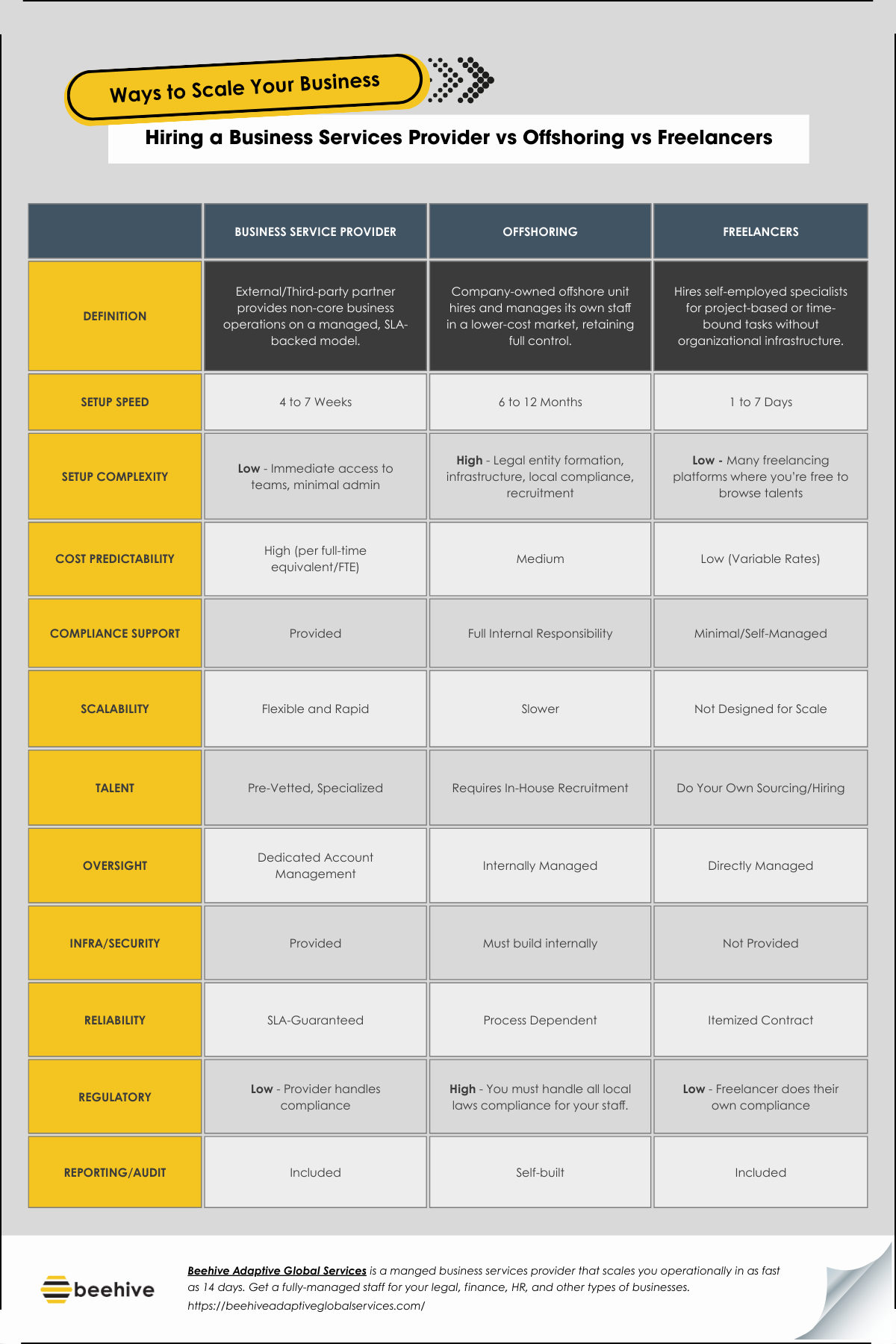
👉🏻 Download Difference of Business Service Provider vs Offshoring vs Freelancer
How to Scale with a Business Process Services Provider
If you think you’re ready to scale and outsource to a third-party provider, here’s a general overview of what to expect.
- Diagnose and Map Out Your Needs
Assess which processes hold your business back—common targets include payroll, benefits, accounting, contract management, customer service, sales support, and inventory. Benchmark costs and pain points. Gather requirements from operational leads. - Choose the Right Partner
Vet experienced Business Process Services Provider for certifications, industry experience, and client outcomes. Demand references and proof of compliance (SOC 2, ISO 27001, HIPAA/PCI if applicable). Evaluate onboarding, training, communication plans, and dedicated account management. - Build the Financial and Operational Case
Evaluate total cost of ownership—including direct, indirect, and compliance costs—against BSP proposals. Leading companies measure success not only by initial savings but also by process improvements, scalability, and reduced regulatory exposure. - Plan and Implement a Structured Transition
Work closely with the Business Services Provider’s implementation team. Map workflows, document protocols, and set up joint training. Run a “soft launch” or pilot phase to catch problems before scaling fully. Ensure secure data migration and access controls. - Monitor, Optimize, and Govern
Track agreed KPIs, SLA performance, and compliance through dashboards and regular reviews. Adjust processes and headcount as business needs change. Use lessons from the first implementation to expand managed services into new functional areas
Compliance and Regulatory Hurdles
Your business services provider can help businesses comply with a maze of U.S. federal and state laws: DOL, CCPA, HIPAA, SOX, and more.
Leading providers use built-in compliance controls, transparent reporting, and up-to-date audits to reduce the risk of fines or business disruption. Contract terms should specify data safeguarding measures, audit rights, and protocols for handling regulatory changes.
Pricing
How much does it cost to hire a business services provider for your non-core operations?
Standard U.S.-oriented service provider pricing for full-time equivalent (FTEs) as of 2025, involving non-core operations like customer service, contact center, and telesales:
- 10 FTEs: $18,000–$24,000/month
- 50 FTEs: $90,000–$120,000/month
- 100 FTEs: $180,000–$240,000/month
Expect premiums for regulated sectors or highly specialized roles (finance, legal, healthcare).
What are the factors that might influence the price of hiring a third-party service provider?
Not all managed service providers are the same. Some countries also provide more specialized services, just because they are more experienced than others.
For example, the Philippines is known for providing high-caliber business process outsourcing and customer support services with good English diction and business-level conversational skills. It’s also known for more technical skills, like legal and HR support services.
India is a long-standing leader in IT and software development, while Vietnam is well-known for its engineering and design expertise.
Here are other factors that might influence the pricing model:
Location of provider
The country or region where the provider operates has a direct impact on costs. Labor market conditions, average wages, and regulatory compliance requirements differ significantly by geography.
Providers in Southeast Asia may offer cost efficiencies due to lower labor costs. In contrast, U.S.-based providers typically charge higher rates but can deliver advantages in time zone alignment, cultural familiarity, and adherence to U.S. legal standards.
Duration of contract
Longer-term contracts often allow for more favorable pricing because they provide revenue stability for the provider.
By committing to multi-year agreements, businesses can unlock volume discounts, improved resource allocation, and strategic benefits such as workforce continuity. Short-term contracts, on the other hand, may cost more due to higher operational risk and onboarding requirements.
Type of work
The level of specialization required significantly impacts pricing.
Routine administrative or back-office work can be priced competitively, while highly technical services, such as legal process support, advanced data analytics, or software engineering, command higher fees due to the need for subject-matter expertise, specialized training, and compliance safeguards.
Contract volume
The scale of services requested (e.g., number of seats, number of transactions processed, or size of customer base covered) strongly influences the pricing model. Providers often apply bulk pricing, meaning that the larger the service volume, the lower the unit cost. This creates opportunities for scalable savings as businesses expand their partnership.
Other factors
Additional variables also shape pricing, including technology requirements (cloud platforms, CRMs, AI-enabled tools), industry-specific compliance obligations (HIPAA for healthcare, GDPR for European operations, or U.S. federal labor standards), and language or cultural training.
Providers with proven track records in regulated industries or high-stakes sectors may command a premium but deliver greater risk mitigation.
Expand your operations with
a fully-managed remote team
Beehive Adaptive Global Services can help you save up to 70% in overhead costs versus hiring internally.
FAQs About Hiring a Business Services Provider
What is a business services provider?
A business services provider, such as Beehive Adaptive Global Services, is a company you can hire to do support services for your company. For example, as an accounting firm in the US, you can remotely hire a business services provider to do specific processes like tax compliance or customer support for your clients. You can treat the provider as a white-label hire.
Why is hiring a business services provider better than offshoring?
Hiring a business services provider may be better than offshoring if you don’t want to register as a business in another country where you want to outsource. It’s less capital-intensive and you can onboard a team in as quick as 2 weeks with the right provider. A provider can source, hire, onboard, train, manage, and report as part of the commitment.
What types of companies can outsource to a provider?
Most types of companies, like HR firms, law firms, accounting firms, logistics companies, and corporations, can outsource their work to a remote business services provider. For example, a financial services firm in the US can tap a business services provider in a low-labor cost country to do the debt settlement portion of their workflow.
Is it possible to hire only a few people to fill my needs?
Most providers have a minimum requirement of fully employed equivalent hires, which may range from filling 10 seats to 50 seats.
How much does it usually cost to hire a business services provider?
There are a number of factors that are considered, including the provider’s location, the expertise or service to be provided, how many fully employed equivalent hires you need, and the duration of the contract. Book a call with potential providers to know more about their pricing model.