

Approximately 74% of companies outsource to access specialized knowledge and talent to overcome shortages, while 66% of US companies outsource at least one department. Hiring Business Process Service vs. Freelancers is one of the key decisions companies face when outsourcing work efficiently. The United States is one of the top contractors sourcing business services from countries with low-cost, highly skilled labor, such as the Philippines, India, Vietnam, and China.
Micro businesses build remote freelance teams outside the US, and small to medium businesses tend to hire agencies or Business Process Services providers to grow. But what’s the difference between outsourcing to freelancers vs a done-for-you agency?
We’ve done a deep dive comparing business process services vs offshoring vs freelancing here →.
In this blog, we’ll discuss:
- Technical differences in business models: freelance remote team vs business process service companies.
- Common regulatory and financial hurdles of hiring remote freelance teams vs BPS companies.
- Detailed comparison of their quality control, flexibility, management, communication, reliability, risks, and others.
Outsourcing continues to be a key strategy for businesses aiming to reduce costs and improve efficiency. You can delegate specific tasks or functions to external providers to streamline operations and focus on core activities
Business Process Service vs Freelancers (Full-Service Teams vs Independent Experts)
This section outlines how Business Process Services and Freelancers differ in structure and operational support. Freelancers can be experts who act independently under a mutually agreed-upon service contract. They’re usually hired on a per-project basis or on a monthly retainer. You can hire them again for another project once the current one is complete.
A Business Process Services provider, such as Accenture, KPMG, McKinsey, or Beehive Adaptive, is a done-for-you model from sourcing and hiring people to training and managing them.
What does it mean to hire a freelancer?
Are you thinking of hiring a freelancer to augment a need in your business? Here are the benefits and other considerations, before diving in.
- Little to no onboarding. They’re equipped with the skills required to complete the project.
- Simple process: Service demo → Contract Signing → Payment → Project Discussion → Creation/Rendering the Service → Approval/Revision → Completion.
- Will work best for consultancy services and retainer-based relationships.
What Freelancers are:
- Solo specialists who work outside your internal workflow.
- They bring a special skill to complete a specific project, including advisory services.
- Requires a one-time payment for services, usually upfront.
What Freelancers are not:
- Freelancers are not “part of your team”. They don’t participate in internal meetings or be part of strategy.
- They are not covered by your company’s internal policies, security protocols, or training processes.
What does it mean to hire a full-service team/agency
Many US businesses hire a business process services (BPS) provider like Beehive Adaptive Global to render a part of their workflow without having to move their business operations or build a branch in another country.
- End-to-end service delivery
- Ongoing support and management
- Access to experts in various fields
What a BPS is:
- You can treat this third-party as a white-label service so you can delegate entire functions.
- Structured service agreement with clear KPIs, ongoing deliverables, and long-term partnership potential.
- Scalable and flexible – you can start with a small team of 10 and scale up quicker than hiring internally.
What a BPS is not:
- It’s not a one-off service or project-based.
Direct Comparison of Control, Management, Pricing, Scalability, and More
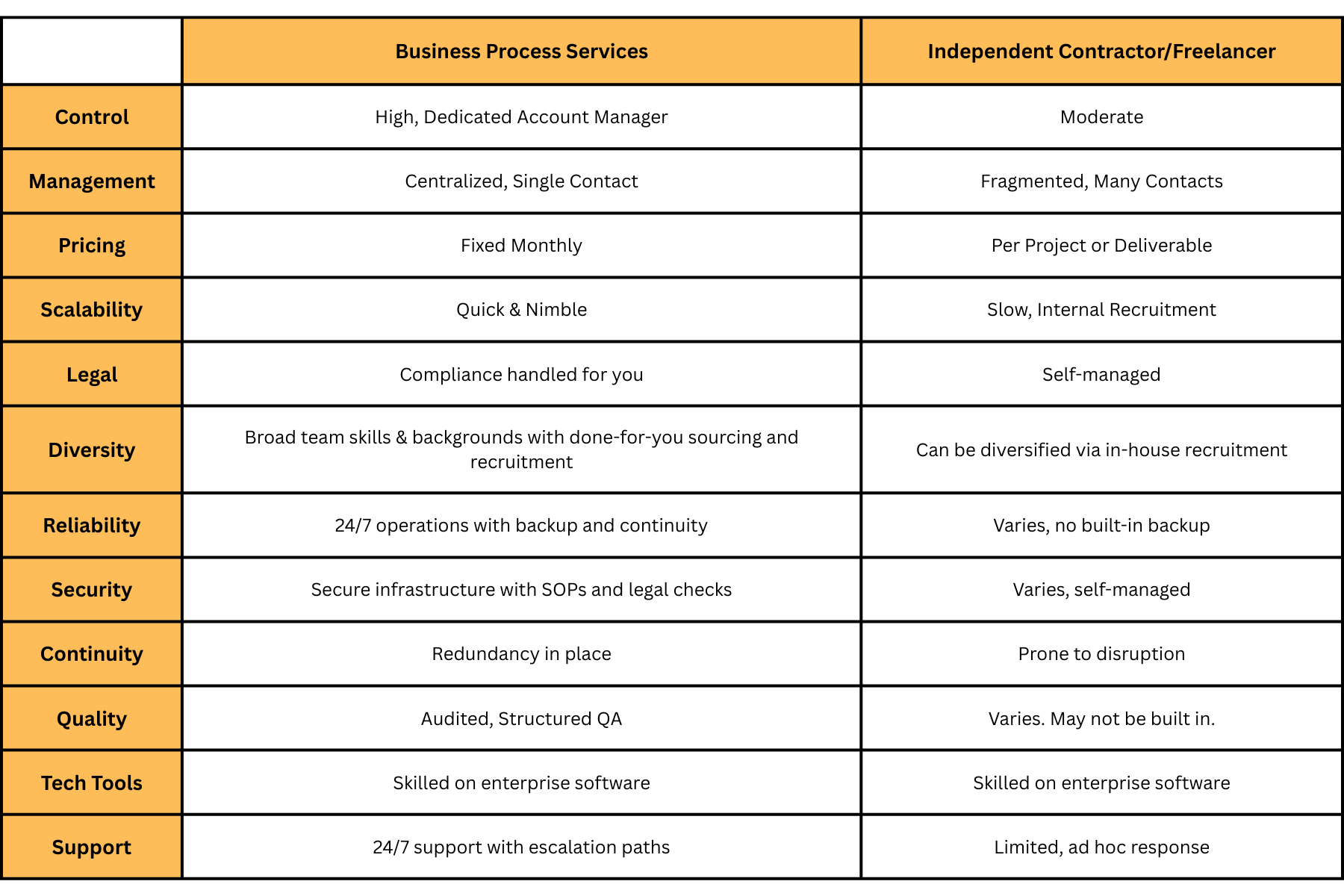
Below is an in-depth comparison that reflects current trends, the global business process outsourcing environment, and the unique advantages/challenges of both models.
Control
A BPS offers high control over the processes and staff. Projects are managed according to contract terms, with transparent reporting and clear escalation paths. A business process services provider offers a dedicated account manager for streamlining communication versus talking to and managing individual freelancers.
Freelancers follow project briefs, which you can control with advance preparation. They work independently and follow the pre-agreed project brief. You have direct communication with a freelancer, but there is no expectation for integration into your daily internal policies or operations.
Daily Management
When evaluating Business Process Services vs. freelancers, management style becomes one of the clearest distinctions. Daily oversight looks very different when comparing Business Process Services vs. freelancers in real workflows.
A BPS provides you with direct oversight through an account manager. The provider manages coordination with the team and reports directly to you or your business leaders. You have control capabilities in terms of project workflows and daily work oversight.
Working with freelancers requires business owners to manage several individuals directly. Communication can be fragmented, with each freelancer operating on their own schedule, making it harder to coordinate large, multi-person projects or ensure cultural alignment.
Cost Structure
A BPS offers predictable monthly/bundled pricing models, based on how many full-time equivalent seats you want to fill. Service agreements often include fixed rates to reduce budget surprises and make planning easier. Great for long-term engagements—outsourcing can lower overall operational costs by up to 60% compared to US onshore or internal staffing.
Freelancer payments offer cheaper rates for short-term work, but total costs can rise for ongoing or multi-project relationships. Costs vary per specialist and project. Payments are often upfront, per milestone, or at completion. The pricing comparison for Business Process Services vs Freelancers also highlights long-term value differences.
Scalability
A major advantage shown in a business process services vs freelancers comparison is the ability to scale faster with a managed BPS team.
You can be highly scalable with a BPS partner. Providers like Beehive Adaptive Global Services can quickly ramp teams up or down, provide multi-disciplinary talent, and adjust service volume across business cycles. Most can add 10+ staff within 30 days, offering flexible workforce expansion without new hiring rounds.
Expanding a project means sourcing, vetting, and managing multiple freelancers, which takes time and may disrupt workflow continuity. There is limited scalability with freelancers.
Legal Requirements of the Partnership
A good BPS handles compliance with employment, data privacy, and local labor laws in the outsourcing destination country. Contracts usually meet international standards and cover tax, HR, and operational risks to reduce your business exposure.
Freelancers handle their own tax compliance. There is less paperwork with freelancers. The complication comes when you’re handling multiple freelancers from different countries with different labor laws and tax laws.
Talent Diversity
A BPS is your access to large, cross-functional teams covering everything from admin to specialized support. They typically have a structured recruitment process to attract a high level of talent diversity. Over 70% of global outsourcing firms staff multiple disciplines and languages.
Freelancer sourcing is limited to individual skills and specialties. Assembling a diverse team requires contacting and managing multiple people. May not cover broader business functions or provide backup talent when core team members are unavailable.
Reliability
Reliability is another major point of contrast in the Business Process Services vs Freelancers debate.
Providers operate under SLA agreements, provide backup staffing, and maintain service continuity even during absences or turnover. 24/7 coverage is available from most mature providers. Expect a reliable partner in a BPS, whether you have a small team of 10 or a large team of hundreds.
Freelancers can be reliable, but work is disrupted by absence, sickness, and other issues. There’s no guarantee of continuity or backup unless separately arranged, making business interruptions more likely.
Security and Compliance with Local Laws
A BPS implements strong data protection, follows GDPR/local regulations, and ensures secure infrastructure. Formal compliance policies protect client IP and sensitive data and maintain audit trails.
Security depends on individual freelancer practices. Risk of data leakage or non-compliance with privacy standards is higher, especially for cross-border projects. No built-in legal or regulatory oversight unless separately contracted
Business Continuity
A BPS maintains robust redundancy systems, backup teams, and disaster recovery plans to ensure uninterrupted service. 92% of top BPOs guarantee recovery protocols and proactive risk planning
Freelancers may not have built-in redundancy and business continuity. You have to self-manage replacement and backup sources. Project delays and knowledge loss can result from freelancer turnover or unavailability.
Quality Control
A key factor in a Business Process Services vs Freelancers comparison is the level of standardized quality control.
BPS has structured QA policies, performance metrics, and continuous improvement cycles. Providers conduct regular audits and training, aiming to maintain or surpass defined service standards.
A formal process control or standardized review can be specified in the freelancer contract. Results vary widely, and you become the gatekeeper for the freelancer’s output.
Tech/Tools
A BPS works on tech tools that your company provides or pays for (it may also be folded into the contract). The provider will usually hire people who already have expertise in the tech tools that you use, and they can provide maintenance, integration, and upgrades.
Freelancers usually have their own tech tools, and you may not have control over what they use as long as they complete the project. That’s unless you look for a provider who uses a specific tool. Either way, the cost of tool subscription is usually folded into their fixed rates.
Support
Business Process Services Providers have dedicated customer support, escalation procedures, and rapid response times. Structured service desk or help channels, available 24/7 in most agencies for operational issues or emergencies
Freelancer support is ad hoc and depends on the freelancer’s working hours, responsiveness, and willingness to address post-delivery questions. No escalation process; all issues must be handled directly by management.
Need a quick consult if partnering with a business services provider is right for you? Contact Beehive Adaptive today. We’ll manage your business offshore, reliably.